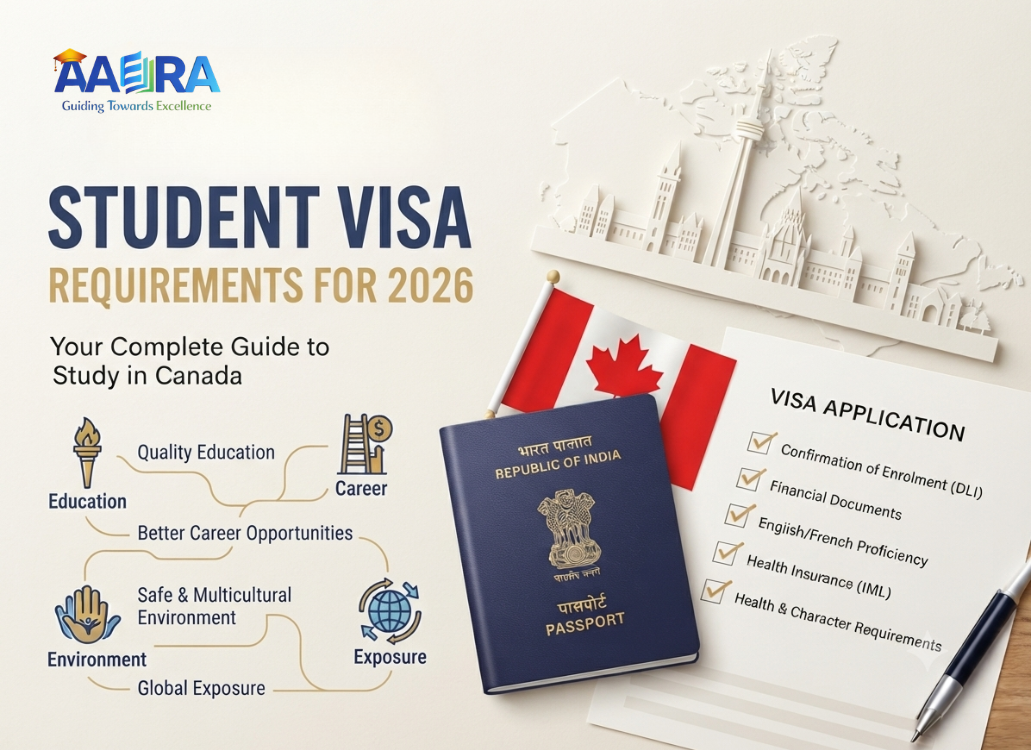
Canada has become one of the most popular destinations for Indian students seeking quality education and better career opportunities. With world-renowned universities, practical learning methods, and a welcoming multicultural environment, Canada offers students an excellent platform to build a successful future. However, before applying, it is important to understand the Study in Canada Requirements 2026 so that your admission and visa process goes smoothly.
Studying abroad is more than just getting admission to a university. Students must select the right course, prepare important documents, understand visa regulations, arrange finances, and plan their careers carefully. This is why many students seek guidance from experienced Study in Canada Consultants in Noida and a trusted Canada Career Mentor for Students. Professional guidance helps students avoid mistakes, choose the right academic path, and improve their chances of success.
This guide explains everything you need to know about studying in Canada in simple language, making it easier for students and parents to plan their study abroad journey confidently.
Why Canada is a Top Choice for Indian Students
Canada continues to attract thousands of international students every year because it offers high-quality education along with excellent career prospects. Canadian universities focus on research, innovation, and practical learning, ensuring students graduate with industry-relevant skills. Some of the biggest advantages of studying in Canada include:
- Globally recognized degrees
- Affordable tuition compared to many other countries
- High-quality education system
- Safe and student-friendly environment
- Multicultural society
- Excellent research opportunities
- Strong employment prospects
- Post-study work opportunities
Canadian qualifications are respected worldwide, allowing graduates to pursue careers in Canada or other countries with confidence.
Study in Canada Requirements for Indian Students
Before beginning your application, you should understand the basic requirements needed for admission and a study permit. Preparing these documents early can save time and reduce the chances of delays. Generally, students require:
- A valid passport
- Academic transcripts and certificates
- Letter of Acceptance (LOA) from a Designated Learning Institution (DLI)
- English language proficiency test scores
- Statement of Purpose (SOP)
- Proof of financial support
- Passport-size photographs
- Medical examination (if required)
- Biometrics
- Study permit application
Every university may have slightly different admission criteria, so students should carefully review the specific requirements of their chosen institution.
Academic Eligibility Requirements
Canadian universities offer diploma, undergraduate, postgraduate, and doctoral programs. The admission requirements vary depending on the level of study.
Undergraduate Programs
Students usually need:
- Completion of Class 12 from a recognized board
- Good academic performance
- English language proficiency
- Additional subject requirements for specific courses
Postgraduate Programs
Applicants generally require:
- Bachelor's degree from a recognized university
- Academic transcripts
- English language test scores
- Work experience for selected professional programs
Meeting the minimum eligibility criteria improves your chances of receiving an admission offer.
English Language Requirements
Most Canadian universities require proof of English language proficiency because courses are primarily taught in English. Accepted tests include:
- IELTS Academic
- PTE Academic
- TOEFL iBT
- Duolingo English Test
- CELPIP (for selected institutions)
The required score depends on the university and program. Students should always check the official admission requirements before applying. Preparing well for the language test can also increase scholarship opportunities at some universities.
Documents Required for Admission
Proper documentation is one of the most important parts of the admission process. Missing or incorrect documents may delay your application.
Personal Documents
- Valid passport
- Passport-size photographs
- Identity proof
Academic Documents
- Class 10 and 12 mark sheets
- Graduation certificates (for postgraduate applicants)
- Academic transcripts
- Degree certificates
Supporting Documents
- Statement of Purpose (SOP)
- Letters of Recommendation (LOR)
- Resume or Curriculum Vitae (if applicable)
- Portfolio (for design-related courses)
Financial Documents
- Bank statements
- Education loan approval (if applicable)
- Sponsor income proof
- Fixed deposits
- Income Tax Returns (ITR)
Keeping all documents updated and organized makes the admission process much easier.
Choosing the Right Course Matters
Many students choose courses simply because they are popular or recommended by friends. However, selecting the right program should depend on your interests, strengths, and career goals. Before making a decision, ask yourself:
- What subjects do I enjoy?
- What type of career do I want?
- Which industries are growing?
- What skills are in demand?
- Does this course offer internship opportunities?
Taking time to answer these questions can help you choose a course that supports your long-term success. Speaking with a Canada Career Mentor for Students can also help you make a more informed decision.
Popular Courses in Canada
Canadian universities offer a wide variety of career-oriented programs. Some of the most popular choices among Indian students include:
Information Technology
Technology continues to be one of Canada's fastest-growing sectors. Popular specializations include Artificial Intelligence, Data Science, Cyber Security, Software Engineering, and Cloud Computing.
Engineering
Engineering remains a preferred choice because of excellent career opportunities. Popular branches include Civil Engineering, Mechanical Engineering, Electrical Engineering, and Computer Engineering.
Business and Management
Students interested in leadership and entrepreneurship often choose MBA, Marketing, Human Resource Management, International Business, and Finance programs.
Healthcare
Canada has increasing demand for healthcare professionals. Popular courses include Nursing, Public Health, Healthcare Administration, and Pharmacy.
Hospitality and Tourism
Canada's tourism industry creates excellent opportunities for graduates in hospitality management and related fields.
Best Universities in Canada
Canada is home to several globally recognized universities known for academic excellence and research. Some of the top institutions include:
- University of Toronto
- University of British Columbia
- McGill University
- University of Waterloo
- Western University
- University of Alberta
- University of Calgary
- York University
- Simon Fraser University
- Dalhousie University
When selecting a university, compare factors such as tuition fees, rankings, scholarship opportunities, internship programs, campus facilities, and graduate employment rates instead of relying only on rankings.
Why Professional Career Guidance Makes a Difference
Studying abroad is one of the biggest investments a student makes. Making decisions without proper guidance can lead to choosing the wrong course or university. Professional Study in Canada Consultants in Noida help students understand admission requirements, shortlist suitable universities, prepare applications, and organize important documents. At the same time, a knowledgeable Canada Career Mentor for Students helps align academic choices with long-term career goals, ensuring students make informed decisions based on industry demand and future opportunities.
Instead of following trends, expert guidance enables students to create a clear roadmap for academic and professional success.
Canada Study Permit Process in 2026
Once you receive your Letter of Acceptance (LOA) from a Canadian university or college, the next step is applying for a Canada Study Permit. This document allows international students to study legally in Canada throughout their academic program.
Step 1: Receive Your Letter of Acceptance
Before applying for a study permit, you must receive an official Letter of Acceptance from a Designated Learning Institution (DLI) in Canada. This letter confirms your admission and is a mandatory document for your visa application.
Step 2: Gather the Required Documents
Prepare all the necessary documents, including your valid passport, LOA, academic certificates and transcripts, English language test results, SOP, proof of financial support, passport-size photographs, and medical examination report if required.
Step 3: Submit Your Application
Students can submit their study permit application online through the official Immigration, Refugees and Citizenship Canada (IRCC) portal.
Step 4: Complete Biometrics
Most applicants are required to provide fingerprints and a photograph at an authorized biometric centre.
Step 5: Wait for Processing
Processing times vary depending on the application period and individual circumstances. Applying several months before your intake is always recommended.
Cost of Studying in Canada
Understanding your education budget is essential before planning your study abroad journey. The total cost depends on your university, course, and city.
Average Annual Tuition Fees
- Diploma Programs: CAD 12,000 – CAD 20,000
- Undergraduate Programs: CAD 18,000 – CAD 40,000
- Postgraduate Programs: CAD 20,000 – CAD 45,000
- MBA Programs: CAD 30,000 – CAD 60,000
Students should always verify the latest tuition fees on their chosen university's official website.
Living Expenses in Canada
Besides tuition fees, students should also budget for monthly living expenses including accommodation, food and groceries, transportation, internet and mobile bills, health insurance, personal expenses, and entertainment. On average, students spend between CAD 1,000 and CAD 2,000 per month, depending on the city and lifestyle. Cities such as Toronto and Vancouver generally have higher living costs than Winnipeg, Halifax, Regina, or Saskatoon.
Planning your finances in advance helps reduce stress after arriving in Canada.
Scholarships for Indian Students
Canada offers several scholarships that help reduce the financial burden on international students. Some common scholarship options include:
- Entrance Scholarships
- Merit-Based Scholarships
- Research Scholarships
- Graduate Assistantships
- University-Specific Scholarships
- Provincial Scholarships
Students with excellent academic performance and strong extracurricular achievements often have better chances of receiving scholarships. Applying early also increases scholarship opportunities.
Career Opportunities After Studying in Canada
Canada is known for its strong economy and growing demand for skilled professionals. International graduates have opportunities across multiple industries.
Information Technology
The technology sector continues to expand rapidly. Popular careers include Software Developer, Artificial Intelligence Engineer, Data Scientist, Cyber Security Specialist, and Cloud Engineer.
Engineering
Engineering graduates remain in high demand across Canada, particularly in Civil Engineering, Mechanical Engineering, Electrical Engineering, and Environmental Engineering.
Healthcare
Canada's healthcare industry offers excellent career opportunities including Registered Nurse, Healthcare Administrator, Pharmacist, and Public Health Professional.
Business and Finance
Business graduates can build careers in Marketing, Accounting, Financial Analysis, Human Resource Management, and International Business.
Hospitality and Tourism
Canada's tourism industry provides opportunities in Hotel Management, Event Management, Travel and Tourism, and Restaurant Management.
Graduates with internship experience often enjoy better employment opportunities.
Benefits of Working with a Canada Career Mentor for Students
Studying abroad is not only about getting admission — it is also about building a successful future. An experienced Canada Career Mentor for Students helps students understand which course matches their interests, skills, and long-term career goals. Professional career mentoring can help students:
- Choose the right course
- Select the best university
- Understand industry demand
- Plan future career opportunities
- Build a long-term career roadmap
- Improve employability
Personalized guidance ensures students make informed decisions instead of simply following popular trends. Connect with AAERA Consultants today to speak with an experienced Canada Career Mentor.
Common Mistakes Students Should Avoid
Choosing the Wrong Course
Selecting a course without considering future career opportunities can affect long-term success.
Incomplete Documentation
Missing financial documents, transcripts, or academic certificates can delay applications significantly.
Weak Statement of Purpose
Your SOP should clearly explain your academic background, study plans, and career goals to the admission committee.
Missing Deadlines
Late applications can reduce scholarship opportunities and delay admissions to the next intake.
Ignoring Professional Guidance
Seeking expert advice early from trusted Study in Canada Consultants in Noida helps students avoid common mistakes and complete the process more efficiently.
🎓 Student Tip
Always begin your university applications and study permit preparation at least 12 months before your intended intake. Early applications give you access to more scholarship opportunities and allow time to fix any document issues without pressure.
Why Choose AAERA Consultants?
Choosing the right education consultant plays an important role in your study abroad journey. AAERA Consultants is dedicated to helping students achieve their international education goals through honest advice and personalized support. Our services include:
- Career Counselling
- University Shortlisting
- Course Selection
- Admission Assistance
- Scholarship Guidance
- SOP & LOR Support
- Visa Documentation
- Interview Preparation
- Pre-Departure Guidance
Whether you need assistance with admissions or career planning, our experienced team is here to support you throughout your journey as trusted Study in Canada Consultants in Noida and experienced Canada Career Mentors for Students.
📞 Contact AAERA Consultants
Office Address: Wave Silver Tower, Noida, D-1072, New Friends Colony, New Delhi – 110025
Phone: +91-9650022154
Email: info@aaeraconsultants.in
Website: aaeraconsultants.in
Instagram: @aaeraconsultants
Frequently Asked Questions (FAQs)
1. What are the Study in Canada Requirements for Indian students?
To study in Canada, Indian students generally need a valid passport, a Letter of Acceptance (LOA) from a Designated Learning Institution (DLI), academic transcripts, English language proficiency test scores, proof of financial support, a Statement of Purpose (SOP), biometrics, and a valid Canada Study Permit. Some students may also need a medical examination.
2. How much money is required to study in Canada?
On average, tuition fees range between CAD 18,000 and CAD 45,000 per year, while living expenses usually range from CAD 1,000 to CAD 2,000 per month. Students should also budget for health insurance, books, and personal expenses.
3. Is IELTS compulsory for studying in Canada?
No. While IELTS Academic is widely accepted, many Canadian universities also accept PTE Academic, TOEFL iBT, and the Duolingo English Test. Students should check the specific language requirements of their chosen institution before applying.
4. Can Indian students work while studying in Canada?
Yes. International students with a valid Canada Study Permit can usually work part-time during their studies and full-time during scheduled academic breaks, provided they meet the conditions of their study permit and current Canadian immigration rules.
5. How long does it take to get a Canada Study Permit?
The processing time varies depending on the country, application volume, and individual circumstances. It is recommended to apply several months before your course begins to avoid delays.
6. How can Study in Canada Consultants in Noida help students?
Professional Study in Canada Consultants in Noida assist students with career counselling, university shortlisting, course selection, admission applications, scholarship guidance, SOP preparation, visa documentation, and pre-departure support.
7. Why should I consult a Canada Career Mentor for Students?
A Canada Career Mentor for Students helps you select the right course based on your interests, academic background, and future career goals. They also provide insights into industry trends, employment opportunities, and long-term career planning.
8. What are the best courses to study in Canada?
Some of the most popular courses include Computer Science, Artificial Intelligence, Data Science, Cyber Security, Business Management, Engineering, Healthcare, Finance, Hospitality Management, and Information Technology. The best course depends on your interests, skills, and career aspirations.
9. Are scholarships available for Indian students in Canada?
Yes. Many Canadian universities offer merit-based scholarships, entrance scholarships, research funding, and financial aid for international students. Applying early and maintaining a strong academic record can improve your chances of receiving a scholarship.
10. Why choose AAERA Consultants for studying in Canada?
AAERA Consultants provides personalized support throughout the study abroad journey including career counselling, university selection, admission assistance, scholarship guidance, visa documentation, SOP and LOR support, and pre-departure counselling. We help students make informed decisions that align with their academic and career goals.